
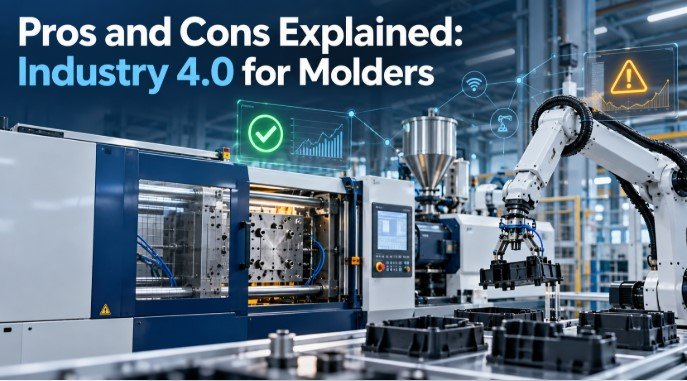
Pros and Cons Explained: Industry 4.0 for Molders
Summary
Industry 4.0 is moving from buzzword to shop-floor reality in plastic injection molding, with industrial IoT sensors, predictive maintenance and AI-assisted quality control replacing guesswork with real-time data. For molders, the appeal is straightforward: fewer unplanned stops, tighter process control and full shot-by-shot traceability. But the shift is not simple or free – legacy machines that cannot talk to modern software, rising cybersecurity exposure, a widening workforce skills gap, and real upfront cost all stand between a molder and a clean rollout. This guide lays out exactly what Industry 4.0 looks like inside an injection molding shop, weighs the pros and cons plainly with no sales pitch, and gives a practical framework for deciding whether – and how far – to adopt it based on your part mix, volume, and budget. Figures here are general industry patterns, so treat them as a starting point for your own shop-floor evaluation.
Key Takeaways
- What it is: IIoT sensors, real-time monitoring, predictive maintenance, AI-based quality control, and connected data systems layered onto the injection molding process.
- Biggest pros: fewer unplanned stops, lower scrap rates, full shot-by-shot traceability, and measurable energy and material savings.
- Biggest cons: legacy machine compatibility, upfront cost, cybersecurity exposure, and a workforce skills gap.
- Not all-or-nothing: most molders start with one press or one cell, not a full-plant rollout.
- Regulated parts (medical, automotive) tend to see the fastest payback from the traceability Industry 4.0 provides.
- The decision should be driven by your defect rate, downtime cost, and part complexity – not industry hype.
What Does Industry 4.0 Actually Mean for an Injection Molding Shop?
At its core, Industry 4.0 connects the injection molding machine, the mold, and the plant’s software into one data loop. Sensors on the press and inside the cavity track variables like melt temperature, cavity pressure, clamp force, and cycle time on every shot, then pass that data over standard protocols such as OPC UA to a central dashboard. Instead of an operator checking a handful of parts per hour, the system is watching every single one, which is what researchers mean when they describe a modern mold as a cyber-physical system rather than a passive tool.
Layered on top of that connectivity is the analytics side: artificial intelligence and machine learning models trained on historical and live production data to flag drift before it produces scrap, recommend process-setting adjustments, and in some setups, predict a probable defect before the part is even ejected. Robotics and automation for part removal, assembly and packaging round out the picture. None of this requires a molder to rebuild their shop from scratch – most plants add it machine by machine, starting wherever downtime or scrap is costing the most.
The Pros of Industry 4.0 for Molders
The case for Industry 4.0 in injection molding is built on data replacing guesswork. Where a shop once relied on an operator’s experience to catch a developing problem, sensors and software catch it earlier and more consistently, which shows up directly in uptime, scrap rate, and the quality of the records a molder can hand a customer.
| Benefit | What Changes on the Shop Floor | Typical Impact |
|---|---|---|
| Real-time process monitoring | Sensors track melt temperature, cavity pressure and clamp force on every shot | Process drift is caught before parts go out of spec |
| Predictive maintenance | Vibration and temperature trends flag wear before a press actually fails | Fewer unplanned stops, longer machine uptime |
| AI-assisted quality control | In-line defect detection and machine-learning classifiers screen parts automatically | Lower scrap rate, less manual inspection labor |
| Energy and material efficiency | Data-driven process optimization trims cycle time and material waste | Reduced energy draw and resin consumption per part |
| Full shot-by-shot traceability | Every cycle is logged, timestamped and tied to a lot or job number | Easier audits and stronger reporting for regulated customers |
Catching a defect on the line faster is valuable, but it is still a downstream fix. Many of the same issues Industry 4.0 is built to detect can be designed out before a tool is ever cut – see our engineering guide to DFM reviews for plastic parts for how that earlier check works alongside real-time monitoring rather than instead of it.
Not sure where Industry 4.0 fits your production line?
Tell us about your parts, volumes and current pain points – we will walk you through what makes sense and what does not.
The Cons and Challenges Molders Should Plan For
The benefits above are real, but none of them are automatic. Most of the friction molders run into with Industry 4.0 has less to do with the technology itself and more to do with what it takes to connect it to an existing operation – older machines, tight budgets, and a workforce that was trained to run presses, not interpret dashboards.
| Challenge | Why It Happens | How to Mitigate |
|---|---|---|
| Legacy machine compatibility | Older presses were not built with sensors or network connectivity in mind | Use retrofit kits and edge gateways; roll out one press or cell at a time |
| Upfront capital cost | Sensors, software licenses, integration work and training all add up quickly | Start with a single high-downtime or high-scrap cell and prove ROI before scaling |
| Cybersecurity exposure | Connecting machines to a network widens the plant’s attack surface | Network segmentation, access control and ongoing monitoring of connected assets |
| Workforce skills gap | Operators are skilled at running machines, not necessarily at reading process data | Structured training and a phased handoff of monitoring responsibilities |
| Data overload | Collecting every available data stream without a clear use for most of it | Define the decision each data point is meant to inform before collecting it |
These pressures tend to show up hardest in lean, make-to-order environments, where there is little slack to absorb a rocky rollout. Our checklist on just-in-time molding production covers how tight scheduling and new technology adoption interact, which is worth reading alongside this one if your shop runs JIT.
Where Industry 4.0 Pays Off Fastest
Not every part or production line benefits equally. Regulated industries such as medical devices see some of the fastest payback, since the traceability Industry 4.0 provides – a timestamped record of the exact process conditions behind every part – is often close to what the quality system already requires on paper. Our checklist on medical device molding walks through the documentation and validation expectations that make this connection so direct.
Complex geometries are another strong fit. Parts with tight cooling requirements benefit from the same sensor and simulation data that informs good tool design in the first place – see our guide to cooling channel design for how process data and mold design decisions reinforce each other. High-volume, low-complexity commodity parts, by contrast, often see a smaller relative lift, simply because the process was already tightly controlled by sheer repetition before any sensors were added.
Is Industry 4.0 Worth It for Every Molder?
The honest answer is no, not at the same pace or to the same degree. The right starting point depends on where a shop is actually losing money or quality today, not on what competitors are advertising.
- It is probably worth prioritizing if: unplanned downtime or scrap is a known, costed problem; you run regulated or high-complexity parts that demand traceability; or your workforce already has some data literacy to build on.
- It can probably wait if: your presses are near end of life and due for replacement anyway; your current scrap and downtime numbers are already tight; or you have no internal capacity yet to act on the data a system would produce.
In practice, most molders land somewhere in between – piloting Industry 4.0 on one problem cell, measuring the result against the cost of getting there, and using that evidence to decide how far to expand it.
Weighing an Industry 4.0 upgrade for your shop?
Share your current setup and goals and our engineering team will help you map out a realistic, phased plan.
Industry 4.0 in a Global Manufacturing Context
Adoption speed varies a lot by market. Shops that provide plastic injection molding services worldwide are approaching Industry 4.0 at different rates depending on labor costs, energy prices, and regulatory pressure in their region. Where rapid injection molding turnaround is a competitive differentiator – short-run tooling, fast prototype-to-production cycles, frequent changeovers – the automation and real-time monitoring Industry 4.0 enables can meaningfully cut the setup and inspection time between runs. A plastic injection molding company in Australia, for instance, typically weighs smart-factory investment against higher labor costs and distance from major resin suppliers, which can make the automation and efficiency case stronger than it would be in a lower-labor-cost market with cheaper raw-material logistics.
Conclusion
Industry 4.0 is not a single switch a molder flips – it is a set of tools, from IIoT sensors to predictive maintenance to AI-assisted quality control, that a shop can adopt in pieces as the business case justifies each one. The pros are concrete: less unplanned downtime, lower scrap, stronger traceability, and measurable energy and material savings. The cons are just as real: legacy equipment that resists connectivity, upfront cost, cybersecurity exposure, and a workforce that needs new skills to make use of the data. The shops that get the most out of Industry 4.0 tend to be the ones that start with a specific, costed problem – a chronic bottleneck, a stubborn scrap rate, a customer demanding better traceability – rather than adopting the technology because it is trending. Matched to the right problem, it pays for itself; mismatched, it is an expensive dashboard nobody acts on.
Frequently Asked Questions (FAQs)
What is Industry 4.0 in injection molding?
Industry 4.0 in injection molding refers to connecting presses, molds and software into one data system using IIoT sensors, real-time monitoring, predictive maintenance and AI-assisted quality control. Instead of relying only on operator checks, the process is continuously monitored and the data is used to catch problems early, predict maintenance needs and improve consistency from shot to shot.
What are the main benefits of Industry 4.0 for molders?
The main benefits are fewer unplanned downtime events through predictive maintenance, lower scrap rates through real-time and AI-assisted quality control, better energy and material efficiency from data-driven process tuning, and full shot-by-shot traceability that supports audits and customer quality reporting, particularly in regulated industries.
What are the biggest risks of adopting Industry 4.0?
The biggest risks are the cost and difficulty of connecting legacy machines that were not built for connectivity, the upfront capital required for sensors, software and integration, a wider cybersecurity attack surface once machines are networked, and a workforce skills gap, since operators need to be trained to interpret and act on process data, not just run the press.
Do small and mid-size molders need Industry 4.0?
Not necessarily all at once. Small and mid-size molders can start by connecting a few existing machines to monitor basic uptime and downtime, then expand gradually as the data proves its value, rather than committing to a large, plant-wide investment up front.
Can older injection molding machines be retrofitted for Industry 4.0?
Yes, in many cases. Retrofit kits and edge gateways can add sensors and connectivity to older presses, though the age of the equipment, the quality of its existing documentation, and how deeply its controls are exposed all affect how straightforward and cost-effective that retrofit is.
How does Industry 4.0 improve part quality?
It improves quality mainly through real-time monitoring and AI-assisted defect detection, which catch process drift – such as a melt temperature or cavity pressure shift – before it produces out-of-spec parts, rather than relying on periodic manual inspection to find problems after they have already occurred.
Should every molder adopt Industry 4.0 at the same pace?
No. The right pace depends on a shop’s specific downtime costs, scrap rates, part complexity and regulatory requirements. A molder running regulated medical parts has a different business case than one running simple, high-volume commodity parts, so adoption should be matched to each shop’s own problems rather than following a single industry-wide timeline.

A Beginner’s Guide: Medical Device Molding
A Beginner's Guide: Medical Device Molding Summary Medical device molding involves regulatory, quality, and material requirements that go well beyond...
October 3, 2026

Frequently Asked Questions: Injection Molding Cycle Time
Frequently Asked Questions: Injection Molding Cycle Time Summary Cycle time directly determines how many parts a molding machine can produce...
October 3, 2026

Tips for Choosing the Right Approach: Mold Life Cycle Management
Tips for Choosing the Right Approach: Mold Life Cycle Management Summary Mold life cycle management covers everything from initial tooling...
October 3, 2026

 20+ Years Experience
